
- GHG Protocol
- IPCC 2006 & 2019
- BRSR
- CCTS Ready
- ISO 14064
- India-First
ESG compliance. Now it runs itself.
Sustaineve structures your environmental, social, and governance data into permanent, audit-ready records — so your compliance doesn't depend on who you call.
Built for Indian manufacturing · BRSR, CCTS, GHG Protocol, GRI, ISO 14064 and 8 more frameworks
Calculation engine aligned with
The situation most manufacturers are in
The data exists. The system to hold it doesn't.
A mid-size manufacturer with active export relationships handles 12–24 ESG data requests per year. Each one is answered manually, each one takes days, each one produces numbers nobody internally trusts.

Data collection
The data is everywhere except one place
Energy bills. Fuel logs. Water records. Waste manifests. HR files. ESG data lives across every department — never in one system, never structured for compliance. Every reporting cycle starts from the same zero.
Calculation accuracy
The calculation is done by whoever has time
IPCC emission factors, GWP weights, CEA grid values — applied manually, in spreadsheets, by people who weren't hired for this. The numbers come out different every time. Nobody stands behind them.
Traceability & reporting
The report doesn't survive scrutiny
When a buyer audits your BRSR submission or an ISO verifier traces your Scope 2 figures, the chain breaks. No source. No factor. No methodology. The number exists, but it cannot be defended.
We eliminated manual ESG compliance for manufacturers.
The Platform
One system. Every ESG obligation, structured.
Built module by module. Grows with your reporting requirements — not against them.
Carbon emissions, energy, water, waste — every environmental metric your compliance demands.
Employee health & safety, DEI, labour practices, community engagement, supply chain responsibility.
Corporate governance, risk management, policies, and reporting transparency.
Environment module: live. Social & Governance: arriving Q3 2026.
How it works
Compliance that runs on your data, not on coordination.
Three steps. One system. Every framework you face.
Capture
Structure at source
Guided input for energy, fuel, water, waste, and emissions data. Every entry validated, timestamped, and mapped to GHG Protocol source categories — at the moment it enters the system.
- Facility-level inputs
- Multi-source upload
- Data validation at entry
Calculate
IPCC-grade methodology
IPCC 2006 & 2019 emission factors applied automatically. India CEA grid values embedded. All 7 Kyoto gases tracked. Every tCO₂e calculated with a full audit trail — source to result.
- IPCC 2006 & 2019 emission factors
- GWP-weighted tCO₂e output
- Full calculation audit trail
Report
Any framework, same data
Select your framework. BRSR, GHG Protocol, CCTS intensity, GRI 305, SBTi. The same verified dataset produces every output — collected once, reportable infinitely.
- BRSR Principal disclosure
- GHG Protocol aligned
- Export-ready format
We made compliance survive on its own.
Platform Preview
The platform your compliance team will actually use.
Built for plant managers, sustainability heads, and CFOs — structured around how manufacturing data actually flows, not how generic ESG tools expect it to.
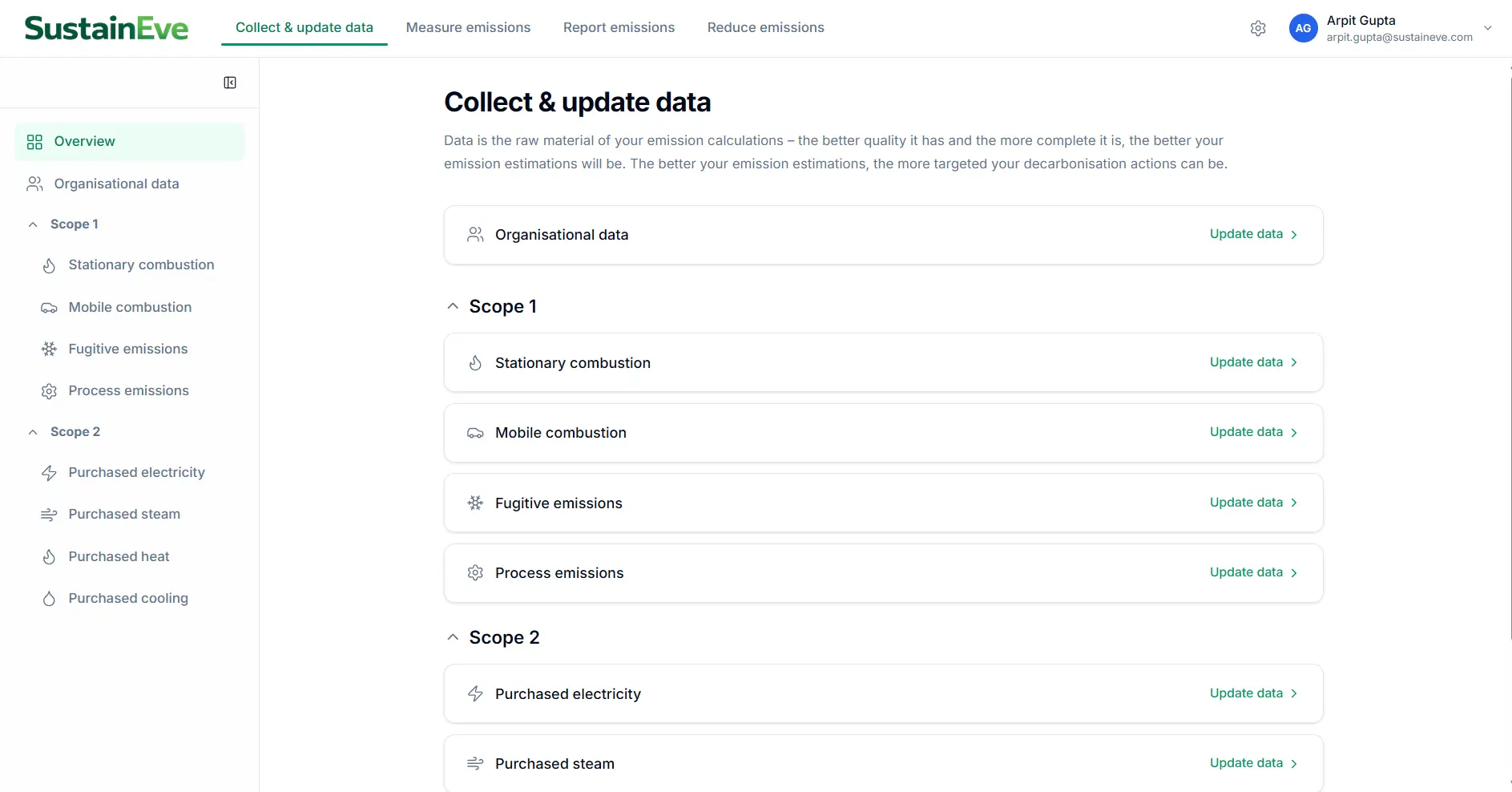
Structured data collection — zero spreadsheets.
Every Scope 1 and Scope 2 source in a single structured interface. Stationary combustion, mobile combustion, fugitive emissions, purchased electricity — guided entry with validation at input.
ESG Overview
Every obligation, in one view.
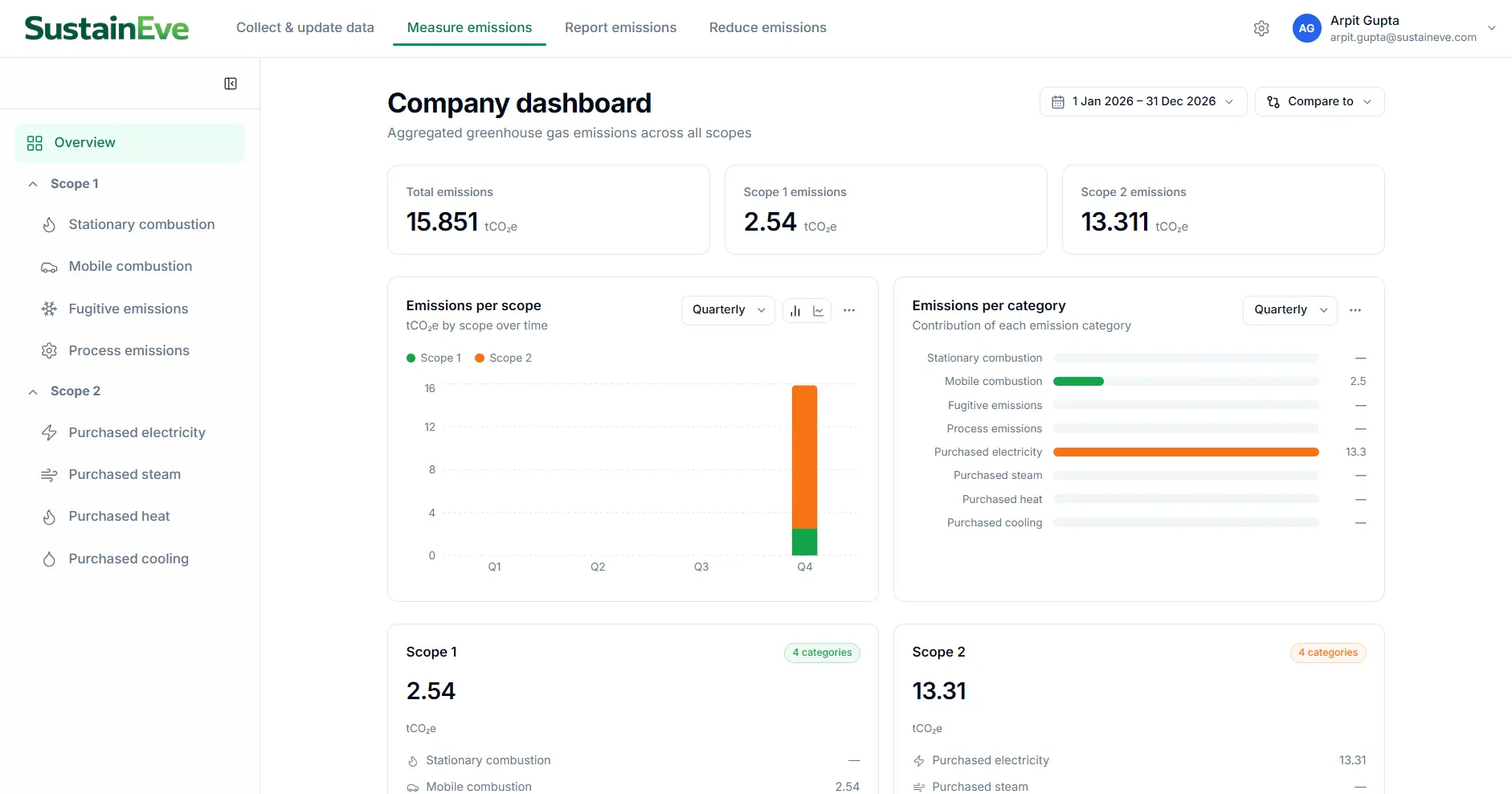
Environment, Social, and Governance data in a unified dashboard. Scope 1, 2 & 3 emissions, water use, waste generation — with quarterly trending and per-source breakdown.
Full ESG module coverage
Environment live. Social & Governance arriving Q3 2026 — same platform, no migration.
IPCC 2006 & 2019 emission factors
Every tCO₂e traceable to IPCC source category and GWP value.
Full audit trail per calculation
Data source → emission factor → methodology. Export in one click.
11 frameworks supported
BRSR, CCTS, GHG Protocol, GRI, SBTi — same dataset, every output.
Standards & Methodology
Built on the standards that auditors actually check.
Sustaineve applies IPCC 2006 & 2019 Refinement emission factors, GHG Protocol Corporate Accounting Standard, and India CEA grid factors. The same methodology a third-party verifier will trace when they audit your inventory.
Reports we generate

Business Responsibility & Sustainability Reporting

GHG Protocol Corporate Standard

Carbon Credit Trading Scheme India

Science Based Targets initiative

CDP Climate Disclosure

Global Reporting Initiative Standards

EU Corporate Sustainability Reporting Directive
SEBI ESG Disclosure Requirements
Standards our calculation engine complies with

IPCC Emission Factor Guidelines

ISO 14064 GHG Accounting Standard

ISO 14046 Water Footprinting Standard

Taskforce on Nature-related Financial Disclosures
11 frameworks supported. Standards embedded in the calculation engine — not added as labels after the fact.
Why Sustaineve
The old approach was never built to scale.
Excel files and annual consultant visits made sense when reporting happened once a year. ESG data is now requested 12–24 times a year, across buyers, regulators, and lenders. The old model breaks at frequency.
BRSR-native reporting output
India criticalSection C Principal disclosures, mapped from Scope 1 & 2
Sustaineve
✓ Yes
Excel+Consultant
✗ No
Global ESG
⚠ Partial
CCTS emission intensity tracking
CCTSIndia Carbon Credit Trading Scheme — April 2025 active
Sustaineve
✓ Yes
Excel+Consultant
✗ No
Global ESG
✗ No
India state-wise CEA grid factors
India criticalCEA 2023 state-specific Scope 2 values
Sustaineve
✓ Yes
Excel+Consultant
Manual
Global ESG
✗ No
Manufacturing source coverage
Coal boilers, diesel fleets, DG sets, refrigerant fugitives
Sustaineve
✓ Yes
Excel+Consultant
Manual
Global ESG
⚠ Partial
Full audit trail per calculation
Source → factor → methodology → standard version
Sustaineve
✓ Yes
Excel+Consultant
✗ No
Global ESG
⚠ Partial
GHG Protocol Corporate Standard
Scope 1 & 2 inventory to Corporate Standard
Sustaineve
✓ Yes
Excel+Consultant
⚠ Partial
Global ESG
✓ Yes
Price point for Indian MSMEs
₹10–500Cr turnover manufacturers
Sustaineve
₹1.5–3L/yr
Excel+Consultant
₹5–15L/yr
Global ESG
$10,000+/yr
Time to first report
From onboarding to first compliance output
Sustaineve
Days
Excel+Consultant
Months
Global ESG
Months
The alternative isn't cheaper. It's more expensive, more fragile, and harder to defend when the numbers are questioned.
Book a comparison demoIndustries
Manufacturing has specific emission sources. Sustaineve is built around them.
Boilers, generators, fleet, refrigerants, purchased electricity — every source category mapped to GHG Protocol and IPCC methodology, for the industries that actually operate them.

Fashion & Apparel
Garment manufacturers, spinning mills, composite units, dye houses

Home Furnishing
Bedsheets, towels, curtains, upholstery — global retail supply chains

Textiles
Spinning, weaving, processing — full textile value chain emissions

General Manufacturing
Broad manufacturing — any sector with GHG Protocol obligations

Chemicals
Process emissions, fugitive emissions, high Scope 1 intensity

Steel & Cement
CBAM Annex I — direct financial compliance exposure from 2026

Aluminium
CCTS first-wave sector — emission intensity targets active from April 2025

Pulp & Paper
CCTS first-wave sector — emission intensity compliance year running
The depth compliance actually demands
Industrial emissions at scale demand calculation-grade infrastructure — not estimates.
73%
of global GHG emissions
are Scope 1 & 2 — direct combustion and purchased energy
IEA / GHG Protocol
24%
from industry alone
Manufacturing is the single largest Scope 1 emitting sector globally
IPCC AR6 WG3
92
countries · GHG Protocol
The world's most adopted corporate GHG accounting standard
GHG Protocol
3
Kyoto gases per source
CO₂, CH₄, N₂O — each GWP-weighted to tCO₂e per IPCC AR6
IPCC 2006 & 2019
11
ESG frameworks supported
BRSR, CCTS, GHG Protocol, GRI, SBTi and 6 more — same dataset, every output
3
Complete scope coverage
Scope 1 direct · Scope 2 indirect · Scope 3 value chain — all 15 categories
7
Kyoto gases tracked
CO₂, CH₄, N₂O, HFCs, PFCs, SF₆, NF₃ — GWP-weighted per IPCC AR6
We built autopilot for ESG.
From data to disclosure
From scattered records to board-ready disclosure — in a defined sequence.
Connect your sources
Guided input for energy bills, fuel records, water logs, waste manifests, and workforce data. No integration required to start. Multi-facility from day one.
The system calculates
IPCC emission factors apply automatically. Scope 1, 2, and 3 calculated. All 7 Kyoto gases tracked. Audit trail generated per entry — no manual conversion, no interpretation.
Compliance output, on demand
Select your framework. Generate the report. BRSR, CCTS, GHG Protocol, GRI — the same verified dataset produces every output. Download, share, or submit with full traceability.
We made compliance survive on its own.
Early Access
The manufacturers who structure their ESG data now will be the ones who can prove it when it matters.
Sustaineve is in active deployment with early manufacturing partners. If your facility is in scope for CCTS, BRSR, or international buyer ESG requirements — this is the right time to start.
No commitment. A genuine conversation about your compliance situation. Response within 48 hours.
Regulatory timelines
CCTS Compliance Year
Active · April 2025
BRSR Mandatory Threshold
Top 500 + supply chain cascade
EU Buyer ESG Requests
12–24 per year · mid-size exporters
India Carbon Market
9 sectors · Textiles included
Resource Library
Compliance guides for manufacturing teams.
CCTS Compliance Starter Guide for Textile Manufacturers
What the Carbon Credit Trading Scheme means for your factory. Baseline calculation methodology, registration requirements, and compliance timeline — for CCTS first-wave sectors.
BRSR Reporting Guide for Manufacturers
Step-by-step walkthrough of BRSR Principal disclosures — what data you need, how emissions are reported, and what auditors check.
Scope 1 & 2 Calculation Handbook
Detailed methodology for calculating Scope 1 and Scope 2 emissions per GHG Protocol and IPCC 2006 & 2019 Refinements — with worked examples.
Textile Industry Carbon Footprint
Key emission sources in textile manufacturing — dyeing, spinning, weaving — and how to account for each under GHG Protocol.
Your compliance data exists somewhere. Sustaineve makes it yours.
Structured. Traceable. Always current. Ready for every buyer, every regulator, every auditor — without a coordination sprint each time.
No sales pressure. Your compliance situation, our genuine analysis.